


Benzodiazepine Addiction: How to Get Help Safely


Benzodiazepine Addiction: How to Get Help Safely
Benzodiazepines are among the most commonly prescribed medications in the United States. They work quickly for anxiety, panic disorders, and insomnia. They also produce dependence faster than most people realize, and withdrawal from benzodiazepines is one of the few substance withdrawals that can be fatal without medical supervision.
This guide covers what you need to know about benzodiazepine addiction and treatment: common medications, why withdrawal is medically serious, the taper process, the distinction between dependence and anxiety, and treatment options in Virginia.
CRITICAL SAFETY WARNING: Do NOT stop benzodiazepines cold turkey. Benzodiazepine withdrawal can cause seizures and death. Any dose reduction must be medically supervised. If you are considering stopping, call your prescriber, a licensed treatment provider, or SAMHSA National Helpline at 1-800-662-HELP first.
Common Benzodiazepines: Xanax, Valium, Klonopin, Ativan
The four most commonly prescribed benzodiazepines have important differences:
Alprazolam (Xanax). Fast-acting, short half-life. Prescribed for anxiety and panic. High addiction potential. Produces particularly strong rebound anxiety between doses.
Diazepam (Valium). Longer half-life. Prescribed for anxiety, muscle spasms, alcohol withdrawal, and seizures. Often used as the taper medication for other benzodiazepines because the long half-life produces smoother dose reduction.
Clonazepam (Klonopin). Longer half-life. Prescribed for anxiety, panic, and seizures. Popular for chronic anxiety management.
Lorazepam (Ativan). Medium half-life. Prescribed for anxiety, insomnia, and acute agitation. Common in hospital settings.
Other benzodiazepines include Restoril (temazepam), Halcion (triazolam), Serax (oxazepam), and Librium (chlordiazepoxide). Z-drugs (Ambien, Lunesta, Sonata) are structurally different but produce similar dependence and require similar tapering.
Half-life matters because it affects both the daily dosing pattern and the taper protocol. Short-half-life benzodiazepines like Xanax produce more intense withdrawal symptoms and are typically converted to a longer-half-life benzodiazepine (usually diazepam) before tapering.
Why Benzodiazepine Withdrawal Can Be Life-Threatening
Benzodiazepines work by enhancing GABA (gamma-aminobutyric acid) activity in the brain. GABA is the primary inhibitory neurotransmitter. With chronic benzodiazepine use, the brain adapts by reducing its natural GABA response.
When benzodiazepines are stopped suddenly, the brain is left with reduced natural GABA activity and no medication substitute. The nervous system becomes overexcited. In severe cases, this produces:
- Withdrawal seizures (grand mal seizures can occur without warning)
- Delirium tremens-like states
- Severe hyperthermia
- Cardiac events
- Psychosis
- Death in severe untreated cases
Only alcohol and benzodiazepine withdrawal carry this seizure and death risk. Opioid withdrawal is severe but rarely fatal. Stimulant withdrawal is severe emotionally but not medically dangerous. Benzodiazepines are different.
This is why medical supervision is not optional for benzodiazepine detox. It is the standard of care.
The Medical Taper Process and Why It Takes Time
Medical benzodiazepine tapering follows established principles:
Conversion to a long-acting benzodiazepine. Short-acting benzodiazepines are converted to equivalent doses of diazepam (Valium) using standard equivalency charts. This produces smoother dose reduction because diazepam's long half-life prevents inter-dose withdrawal.
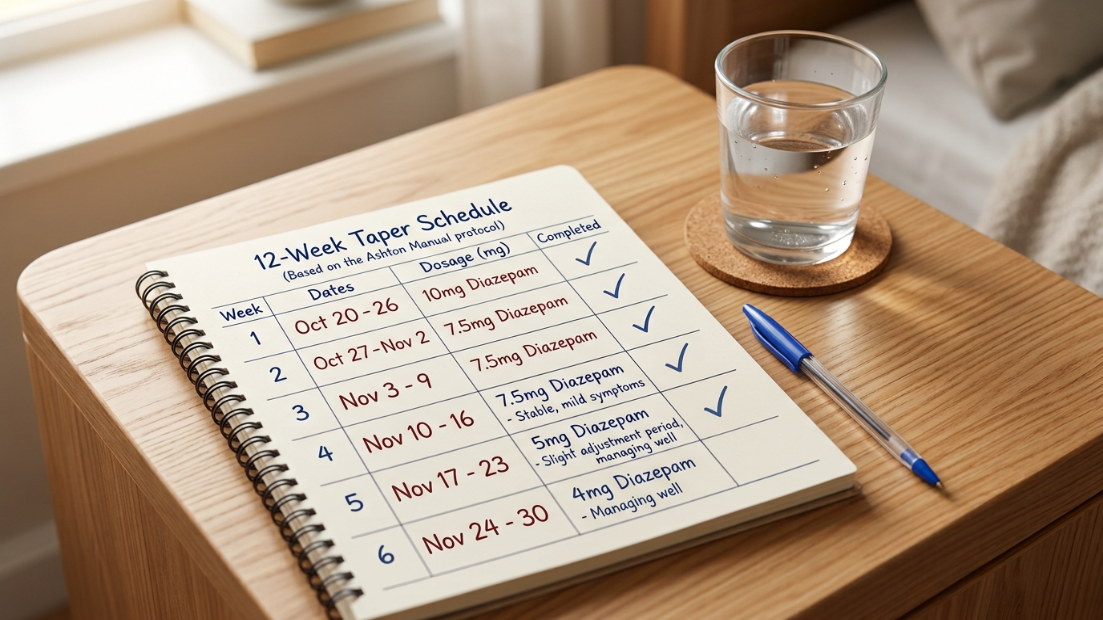
Slow gradual reduction. Doses typically reduce by 10 to 25 percent every 1 to 2 weeks. The exact pace depends on the patient's response. Faster tapers produce more severe withdrawal. Slower tapers produce better outcomes.
Symptom-driven pace. If withdrawal symptoms become intolerable, the taper pauses at the current dose. Reduction resumes when symptoms stabilize. This is not failure. It is proper protocol.
Adjunct medications. Non-benzodiazepine medications may support the taper including anticonvulsants (gabapentin, pregabalin), beta-blockers for physical symptoms, and SSRIs or SNRIs for underlying anxiety.
Full taper duration. Full withdrawal typically takes 8 to 26 weeks for daily-use patients. Some patients require 6 to 12 months for full taper, particularly after years of use. This is normal, not excessive.
The Ashton Manual, developed by Professor Heather Ashton at the University of Newcastle, is the widely used clinical protocol. Modern clinicians adapt her principles to individual patients but the underlying framework remains standard.
Symptoms of Benzo Dependence vs. Anxiety Management
One of the diagnostic challenges is distinguishing dependence symptoms from the anxiety the medication was prescribed to treat. Signs that suggest dependence rather than continued anxiety:
- Rebound anxiety between doses that is worse than pre-medication anxiety
- Needing higher doses over time to achieve the same effect (tolerance)
- Withdrawal symptoms when doses are missed (irritability, tremor, sweating, sleep disturbance)
- Anxiety patterns that follow the medication schedule rather than external triggers
- Physical symptoms (headaches, muscle tension, gastrointestinal issues) that resolve with dosing
- Cognitive symptoms (memory issues, concentration problems, cloudy thinking)
- Emotional blunting
- Preoccupation with medication timing and supply
Once dependence has formed, tapering is often needed to determine whether ongoing anxiety was clinical or was maintained by the medication itself. Many patients discover their baseline anxiety was significantly lower than they realized after a completed taper.
Treatment Options for Benzo Addiction in Virginia
Comprehensive benzodiazepine treatment typically includes:
- Medical taper coordinated by an addiction medicine physician or psychiatrist
- Inpatient or intensive outpatient monitoring during acute withdrawal phases
- PHP or IOP structured programming (30 to 90 days) during and after the taper
- Ongoing individual therapy addressing anxiety, trauma, or other underlying conditions
- Non-benzodiazepine medication management (SSRIs, SNRIs, buspirone) for anxiety
- Anxiety-specific therapies (CBT, DBT skills, mindfulness-based approaches)
- Peer support (AA, NA, Pills Anonymous, or benzodiazepine-specific support groups)
- Management of post-acute withdrawal syndrome (PAWS) which can last 6 to 18 months
What to Expect in Benzo-Specific Medical Detox
If your dependence is severe or your medical situation is complex, inpatient benzodiazepine detox may be indicated. What to expect:
- Medical assessment including complete history, current medications, and physical exam
- Conversion to a long-acting benzodiazepine at equivalent dosing
- Structured taper over 5 to 21 days depending on severity
- 24/7 medical monitoring for seizure risk and other complications
- Adjunct medications for symptom management
- Assessment of underlying anxiety and psychiatric needs
- Coordinated transition to PHP or IOP after acute detox
Outpatient tapering is often possible for less severe cases and requires close prescriber contact throughout. The choice between inpatient and outpatient depends on daily dose, duration of use, history of previous taper attempts, and co-occurring conditions.
Your Next Step
If you are dependent on benzodiazepines, do not try to stop alone. Call your prescriber first. If your prescriber is not helpful or you need specialty care, call a licensed Virginia treatment provider today for a free confidential assessment. Safe taper is possible. Recovery is possible. The path exists.
Take the First Step Today
If you’re ready to explore your options — or just want to ask questions — reach out today. We’ll guide you with clarity, compassion, and confidence.
.svg)
or message us directly through our website
You don’t have to figure this out alone. Let’s take the next step — together.
- Ashton, C.H. Benzodiazepines: How They Work and How to Withdraw (The Ashton Manual). benzo.org.uk
- American Society of Addiction Medicine (ASAM). The ASAM Criteria. asamcriteria.org
- National Institute on Drug Abuse (NIDA). Prescription CNS Depressants. nida.nih.gov
- Substance Abuse and Mental Health Services Administration (SAMHSA). TIP 45: Detoxification and Substance Abuse Treatment. samhsa.gov
- U.S. Food and Drug Administration. FDA Requiring Boxed Warning About Serious Risks of Benzodiazepines. fda.gov
- Lader, M. Benzodiazepines revisited - will we ever learn? Addiction
- American Psychiatric Association. Practice Guideline for the Treatment of Patients with Panic Disorder. psychiatry.org
- Virginia Board of Medicine. Prescribing Regulations.
- SAMHSA National Helpline. 1-800-662-HELP
- Code of Virginia § 38.2-3412.1. Coverage for Mental Health and Substance Use Disorders. law.lis.virginia.gov
Frequently Asked Questions

Related Blog Posts
.png)
Benzodiazepine Withdrawal: Why You Need Medical Detox
Benzo withdrawal can be fatal. Learn why medical detox is essential, how tapering works, the fentanyl-Xanax crisis, and Virginia detox options for 2026.
.png)
Anxiety and Alcohol Abuse: Finding Help in Virginia
Learn how anxiety and alcohol abuse reinforce each other, why alcohol worsens anxiety long-term, and how Bold Recovery in Norfolk VA treats both simultaneously.

Grief and Addiction: When Loss Leads to Substance Use
The link between grief and substance use, types of loss that trigger addiction, integrated dual treatment, and grief support resources in Hampton Roads Virginia.