


How Does Suboxone Work for Opioid Addiction?


Suboxone is one of the most prescribed and most misunderstood medications in addiction treatment. People hear that it is 'an opioid used to treat opioids' and stop there — missing the clinical mechanism that makes it one of the most effective tools available for opioid use disorder.
This post explains exactly how Suboxone works, why it does not produce a high at therapeutic doses, and how Bold Recovery integrates Suboxone treatment in Norfolk, Virginia into a comprehensive recovery program.
What Is Suboxone?
Suboxone is an FDA-approved medication combining two active ingredients:
- Buprenorphine — a partial opioid agonist that reduces cravings and prevents withdrawal
- Naloxone — an opioid antagonist that deters misuse by injection
Suboxone is administered as a sublingual film that dissolves under the tongue. It is typically taken once daily and can be prescribed in an office-based setting — meaning you do not need to visit a specialized clinic every day, unlike methadone.
How Does Buprenorphine Work?
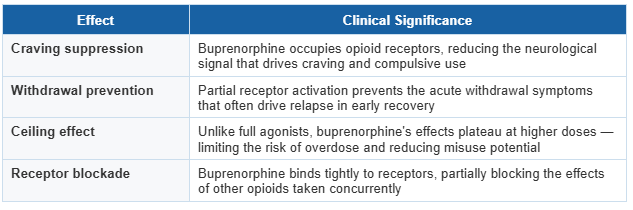
Buprenorphine is a partial opioid agonist. This means it binds to the same opioid receptors in the brain that heroin, fentanyl, and oxycodone activate — but it only partially activates them.
This partial activation produces three critical clinical effects:
What Does the Naloxone Component Do?
Naloxone is added to Suboxone specifically as a misuse deterrent. When Suboxone is taken as directed — dissolved under the tongue — naloxone has minimal bioavailability and does not significantly affect the medication's clinical action.
If Suboxone is crushed and injected, naloxone becomes fully active and precipitates immediate opioid withdrawal. This mechanism substantially reduces the likelihood of injection misuse.
Does Suboxone Get You High?
At therapeutic doses, Suboxone does not produce euphoria in people with opioid use disorder. The partial agonist mechanism means receptor activation reaches a ceiling well below the threshold required for intoxication.
This is the fundamental clinical distinction between Suboxone and the opioids it treats. It stabilizes neurological function without producing the reinforcing effects that drive addiction.
What Does the Research Show?
The clinical evidence supporting Suboxone is substantial:
- Reduces opioid use by up to 75% compared to placebo in controlled trials
- Patients on buprenorphine are 1.82 times more likely to remain in treatment than those on placebo
- Buprenorphine-naloxone treatment is associated with significant reductions in HIV risk behaviors
- Combined with counseling, Suboxone produces superior long-term outcomes compared to either intervention alone
How Does Bold Recovery Use Suboxone in Norfolk, VA?
At Bold Recovery, Suboxone is never a standalone prescription. Every client on a Suboxone protocol participates in a structured treatment program — IOP or PHP — that includes:
- Individual therapy with a licensed clinician
- Group counseling and peer support
- Relapse prevention and coping skills training
- Medication management appointments with clinical oversight
- A collaborative tapering protocol when clinically appropriate
Suboxone provides the neurological stability that makes the clinical work possible. The clinical work provides the behavioral infrastructure that makes recovery last.
Is Suboxone Treatment Covered in Norfolk, VA?
Yes. Virginia Medicaid covers Suboxone treatment under the ARTS benefit. Anthem, Aetna, Cigna, United Healthcare, and most major commercial plans also cover buprenorphine with prior authorization. Bold Recovery's admissions team handles verification and authorization for every client before treatment begins.
Take the First Step Today
If you’re ready to explore your options — or just want to ask questions — reach out today. We’ll guide you with clarity, compassion, and confidence.
.svg)
or message us directly through our website
You don’t have to figure this out alone. Let’s take the next step — together.
- SAMHSA. (2023). Medications for Opioid Use Disorder. Treatment Improvement Protocol (TIP) Series No. 63. Rockville, MD.
- Mattick, R.P. et al. (2014). Buprenorphine maintenance versus placebo or methadone maintenance for opioid dependence. Cochrane Database of Systematic Reviews, 2, CD002207.
- U.S. Food and Drug Administration. (2023). Suboxone (buprenorphine and naloxone) sublingual film prescribing information. Silver Spring, MD.
- American Society of Addiction Medicine (ASAM). (2023). The ASAM Criteria: Treatment Criteria for Addictive, Substance-Related, and Co-Occurring Conditions. 4th ed.
- Virginia Department of Medical Assistance Services. (2024). Addiction and Recovery Treatment Services (ARTS) MAT Coverage Guidelines. Richmond, VA.
- Fiellin, D.A. et al. (2006). Counseling plus buprenorphine-naloxone maintenance therapy for opioid dependence. New England Journal of Medicine, 355(4), 365-374.
Frequently Asked Questions

Related Blog Posts

Does Medicaid Cover PHP in Virginia? | Be Bold Recovery
Find out if Medicaid covers partial hospitalization programs in Virginia, what plans qualify, and how to verify your coverage before starting treatment.

How Long Does an IOP Program Last?
Find out how long IOP programs last in Virginia, what affects duration, and how Be Bold Recovery structures your recovery timeline from start to discharge

Can You Work While Attending an IOP Program?
Find out if you can work while in IOP in Virginia, how schedules are structured around employment, and what Bold Recovery's outpatient program looks like for working adults.