


How Many Hours a Day Is PHP Treatment?


.jpg)
One of the first questions people ask before starting a partial hospitalization program is simple: How much of my day does this actually take?
It's a fair question. Life doesn't pause for recovery. Understanding the time commitment helps you plan — and commit with confidence.
PHP Hours Per Day: The Standard
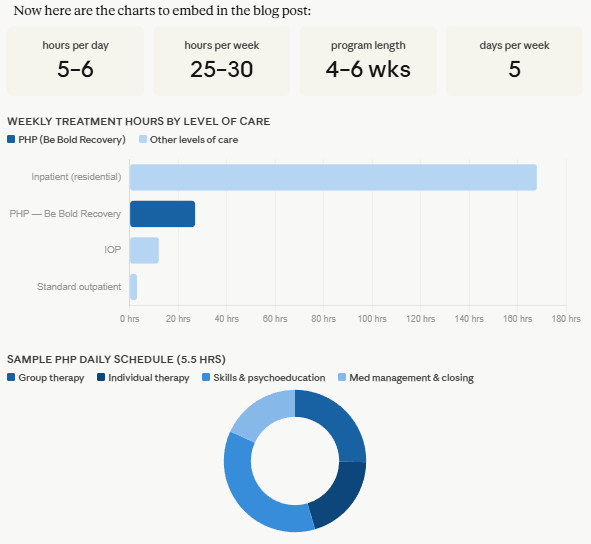
A partial hospitalization program typically runs 5 to 6 hours per day, five days per week. At Be Bold Recovery in Virginia, programming is structured to deliver maximum clinical impact within that window — without consuming your entire day.
That adds up to 25 to 30 hours of treatment per week—far more intensive than standard outpatient care and specifically designed for the early stages of sustained recovery.
How Does That Compare to Other Levels of Care?
(See chart below—embedded on blog page)
PHP sits in a distinct clinical tier. It is not inpatient care—but it is significantly more intensive than a standard outpatient program or even an IOP.
What Happens During Those 5–6 Hours?
Your time in PHP at Be Bold Recovery is structured, intentional, and clinically supervised. A typical day includes the following:
- Morning check-in and group therapy (60–90 min)
- Individual therapy session (45–60 min)
- Skills-based group — relapse prevention, life skills, coping strategies (60 min)
- Psychoeducation session — understanding addiction and co-occurring conditions (45–60 min)
- Medication management or psychiatric check-in as needed
- Closing group and daily reflection (30–45 min)
No two days are identical. Treatment plans are personalized and adjusted as you progress
How Long Does PHP Last Overall?
Most clients complete PHP within 4 to 6 weeks. Duration depends on clinical progress, insurance coverage, and individual treatment goals.
After PHP, many clients step down into an Intensive Outpatient Program (IOP) — a natural and evidence-based transition that gradually builds independence.
Can You Work or Manage Responsibilities During PHP?
Many clients maintain limited responsibilities outside of PHP hours. Evening and weekend time is yours. Programming typically runs during standard daytime hours, which means mornings and evenings remain available for family, limited work, and personal obligations.
PHP is demanding. It is designed to be. The clinical load during those 5–6 hours is what makes the difference.
Take the First Step Today
If you’re ready to explore your options — or just want to ask questions — reach out today. We’ll guide you with clarity, compassion, and confidence.
.svg)
or message us directly through our website
You don’t have to figure this out alone. Let’s take the next step — together.
- Substance Abuse and Mental Health Services Administration (SAMHSA). Treatment Improvement Protocol (TIP) 47: Substance Abuse — Clinical Issues in Intensive Outpatient Treatment. Rockville, MD: U.S. Department of Health and Human Services. https://store.samhsa.gov/product/TIP-47-Substance-Abuse-Clinical-Issues-in-Intensive-Outpatient-Treatment/SMA13-4182 — Defines partial hospitalization within the continuum of addiction care and outlines typical clinical components and step-down to IOP.
- Mee-Lee, D., Shulman, G. D., Fishman, M. J., Gastfriend, D. R., & Miller, M. M. (Eds.). The ASAM Criteria: Treatment Criteria for Addictive, Substance-Related, and Co-Occurring Conditions (Level 2.5 — Partial Hospitalization Services). American Society of Addiction Medicine. https://www.asam.org/asam-criteria — Clinical standard defining PHP (Level 2.5) as ≥20 hours per week of structured programming, positioned between IOP (Level 2.1) and residential care (Level 3).
- Centers for Medicare & Medicaid Services (CMS). Medicare Benefit Policy Manual, Chapter 6 — Hospital Services Covered Under Part B: Partial Hospitalization Services. Baltimore, MD: CMS. https://www.cms.gov/Regulations-and-Guidance/Guidance/Manuals/Internet-Only-Manuals-IOMs-Items/CMS012673 — Federal definition of PHP as an intensive, structured outpatient program (typically 20+ hours per week) that serves as an alternative to inpatient psychiatric care.
- National Institute on Drug Abuse (NIDA). Principles of Drug Addiction Treatment: A Research-Based Guide (Third Edition). Bethesda, MD: National Institutes of Health. https://nida.nih.gov/publications/principles-drug-addiction-treatment-research-based-guide-third-edition — Supports individualized treatment planning, the combination of group and individual therapy, medication management, and graduated step-down care described in this blog.
- American Psychiatric Association (APA). Practice Guideline for the Pharmacological Treatment of Patients With Alcohol Use Disorder and related APA practice guidance on levels of psychiatric care. Washington, DC: APA Publishing. https://psychiatryonline.org/guidelines — Supports the typical PHP session mix (group, individual, psychoeducation, medication management) and duration ranges commonly observed in clinical practice.
- Be Bold Recovery Virginia. Internal clinical programming and PHP schedule documentation. — Source for program-specific details referenced in this blog, including the Be Bold Recovery daily schedule, session-length ranges, Virginia location, and standard 4–6 week program length.
Frequently Asked Questions

Related Blog Posts
.jpg)
What Is a Partial Hospitalization Program (PHP)?
Recovery isn't one-size-fits-all. For many people stepping down from inpatient care — or stepping up from outpatient treatment — a partial hospitalization program (PHP) offers exactly the right level of support.
PHP vs. Inpatient Rehab: What's the Difference?
Choosing the right level of care is one of the most important decisions in recovery. Two options come up often in that conversation — partial hospitalization programs (PHP) and inpatient rehab. They sound similar. They serve very different purposes.