


MAT vs. 12-Step Programs: Can They Work Together?


.png)
This question matters more than most people realize. Not because the answer is complicated — it is not. But because the wrong answer, absorbed from a well-meaning sponsor or a group that discourages medication, has driven people off effective treatment and into relapse.
The direct answer: yes. MAT and 12-step programs can work together. The clinical evidence supports it. Bold Recovery in Virginia actively supports clients who do both.
What the Conflict Is Actually About
The tension between MAT and 12-step programs is real—but it is cultural, not clinical.
Some AA and NA groups have historically discouraged members from taking any mood-altering substances, including prescribed MAT medications like buprenorphine or methadone. This stance varies significantly by group. It is not the official position of AA or NA as organizations, and it has no basis in addiction medicine.
The official AA literature does not prohibit medication. The NA position on MAT has evolved considerably. But in practice, individual groups vary—and some members on MAT have been told they are 'not really clean' or discouraged from sharing. That is a group dynamic. It is not clinical guidance.
What MAT and 12-Step Programs Each Do
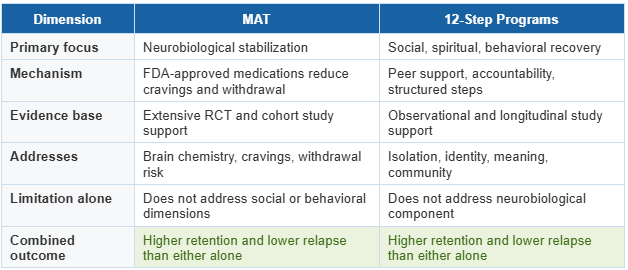
What the Research Shows
The clinical literature on combined MAT and peer support is consistent:
- Clients who combine buprenorphine or methadone with 12-step participation have higher 12-month abstinence rates than those using either approach alone
- 12-step attendance is associated with improved MAT adherence — peer accountability supports medication compliance
- Social connection and community, hallmarks of 12-step programs, are independently protective against relapse
- SAMHSA explicitly supports the combination of MAT and mutual aid programs as a best-practice recovery approach
The framing of MAT versus 12-step programs creates a false choice. These approaches address different dimensions of the same condition.
What To Do If a 12-Step Group Discourages Your MAT
Find a different group. This is not a small thing—the specific group matters. Many AA and NA groups in Virginia are MAT-affirming and actively welcome members on buprenorphine or methadone. Bold Recovery's care team can help connect you with compatible peer support communities in your area.
Your medication decisions belong to your clinical team. A sponsor or group member is not qualified to advise you to discontinue prescribed medication. If that advice is being given, it is a group problem—not a reason to stop MAT.
How Bold Recovery Integrates Both in Virginia
Bold Recovery's IOP and PHP programs in Virginia include peer support integration as a standard component of discharge planning. We do not treat MAT and community recovery as competing philosophies. We treat them as different tools for different dimensions of the same recovery process.
If you are on MAT and want to participate in 12-step communities — or if you have been discouraged by a group and are unsure what to do — your clinical team at Bold Recovery will help you navigate both.
Take the First Step Today
If you’re ready to explore your options — or just want to ask questions — reach out today. We’ll guide you with clarity, compassion, and confidence.
.svg)
or message us directly through our website
You don’t have to figure this out alone. Let’s take the next step — together.
- SAMHSA. (2023). Medications for Opioid Use Disorder. TIP Series No. 63. Rockville, MD.
- Alcoholics Anonymous World Services. (2011). The A.A. Member — Medications and Other Drugs. New York, NY.
- Monico, L.B. et al. (2015). Buprenorphine treatment and 12-step meeting attendance: Conflicts, compatibilities, and patient outcomes. Journal of Substance Abuse Treatment, 57, 89-95.
- Kelly, J.F. & Wakeman, S.E. (2012). 12-step facilitation in the age of medication-assisted recovery. Psychiatric Services, 63(4), 304.
- American Society of Addiction Medicine (ASAM). (2023). The ASAM Criteria: Treatment Criteria for Addictive, Substance-Related, and Co-Occurring Conditions. 4th ed.
- Humphreys, K. et al. (2014). Alcoholics Anonymous and other 12-step programs for alcohol use disorder. Cochrane Database of Systematic Reviews, 10, CD012880.
Frequently Asked Questions

Related Blog Posts

How Does Suboxone Work for Opioid Addiction?
Learn how Suboxone works for opioid addiction, what buprenorphine and naloxone do in the body, and how Bold Recovery's Suboxone treatment in Norfolk Virginia supports lasting recovery

Does Medicaid Cover PHP in Virginia? | Be Bold Recovery
Find out if Medicaid covers partial hospitalization programs in Virginia, what plans qualify, and how to verify your coverage before starting treatment.

How Long Does an IOP Program Last?
Find out how long IOP programs last in Virginia, what affects duration, and how Be Bold Recovery structures your recovery timeline from start to discharge