


PHP vs. Inpatient Rehab: What's the Difference?


Choosing the right level of care is one of the most important decisions in recovery. Two options come up often in that conversation—partialpartial hospitalization programs (PHP) and inpatient rehab. They sound similar. They serve very different purposes.
Here's what separates them — and how to know which one is right for you.
What Is Inpatient Rehab?
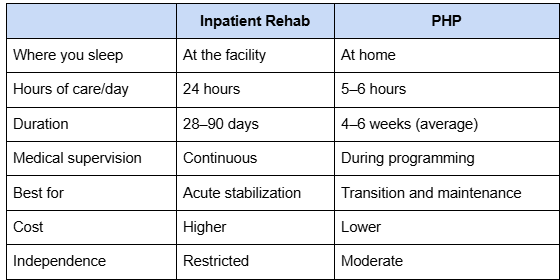
Inpatient rehab is residential treatment. You live at the facility for the duration of your program. It provides 24-hour medical supervision, a fully structured environment, and complete separation from outside triggers.
Inpatient care is typically recommended for:
- Severe addiction with high medical risk
- Active withdrawal requiring medical monitoring
- Unstable home environments
- Previous treatment attempts that didn't hold
- Co-occurring disorders requiring round-the-clock psychiatric support
The average inpatient stay runs 28 to 90 days. The goal is stabilization — getting you physically and mentally safe before transitioning to a lower level of care.
What Is a Partial Hospitalization Program (PHP)?
PHP is intensive structured treatment without the overnight stay. You attend clinical programming five to six hours per day, multiple days per week. You return home each evening.
Be Bold Recovery's PHP in Virginia includes:
- Individual and group therapy
- Medication management
- Relapse prevention and life skills
- Family therapy sessions
- Step-down discharge planning
PHP is not a lesser version of inpatient. It is a clinically distinct level of care designed for a specific stage in the recovery process.
PHP vs. Inpatient Rehab: Side-by-Side
Which One Do You Need?
The honest answer is it depends on where you are in your recovery.
Choose inpatient if you are in active withdrawal, your home environment is unsafe, or your addiction is severe enough to require constant medical oversight.
Choose PHP if you have completed detox or inpatient, your home environment is stable, and you need structured clinical support without full residential care.
Many people move from inpatient directly into PHP. This progression is intentional. It is the evidence-based continuum of care that produces lasting recovery outcomes.
Take the First Step Today
If you’re ready to explore your options — or just want to ask questions — reach out today. We’ll guide you with clarity, compassion, and confidence.
.svg)
or message us directly through our website
You don’t have to figure this out alone. Let’s take the next step — together.
Substance Abuse and Mental Health Services Administration (SAMHSA). (2021). Treatment Improvement Protocol (TIP) 45: Detoxification and Substance Abuse Treatment. U.S. Department of Health and Human Services. https://store.samhsa.gov/product/TIP-45-Detoxification-and-Substance-Abuse-Treatment/SMA15-4131
National Institute on Drug Abuse (NIDA). (2020). Principles of Drug Addiction Treatment: A Research-Based Guide (Third Edition). National Institutes of Health. https://nida.nih.gov/publications/principles-drug-addiction-treatment-research-based-guide-third-edition
American Society of Addiction Medicine (ASAM). (2023). ASAM Criteria: Treatment Criteria for Addictive, Substance-Related, and Co-Occurring Conditions. ASAM. https://www.asam.org/asam-criteria
McLellan, A. T. (2017). Substance misuse and substance use disorders: Why do they matter in healthcare? Transactions of the American Clinical and Climatological Association, 128, 112–130. https://www.ncbi.nlm.nih.gov/pmc/articles/PMC5525418/
Mental Health Parity and Addiction Equity Act (MHPAEA). (2008). U.S. Department of Labor. https://www.dol.gov/agencies/ebsa/laws-and-regulations/laws/mental-health-parity
Frequently Asked Questions

Related Blog Posts
.jpg)
What Is a Partial Hospitalization Program (PHP)?
Recovery isn't one-size-fits-all. For many people stepping down from inpatient care — or stepping up from outpatient treatment — a partial hospitalization program (PHP) offers exactly the right level of support.