


What Are the Signs of Meth Addiction?


.png)
Methamphetamine addiction changes a person visibly and rapidly. The physical, behavioral, and psychological signs are distinctive — and they escalate with continued use in ways that become increasingly difficult to conceal or dismiss.
Recognizing those signs — in yourself or someone you care about — is the first step toward getting help. In Virginia, where methamphetamine use has increased significantly alongside the opioid crisis, that recognition matters.
How Meth Affects the Brain
Methamphetamine is a powerful dopamine agonist. A single dose floods the brain's reward system with 3 to 5 times the dopamine produced by natural pleasurable activities. This extreme dopamine surge produces the intense euphoria that drives initial use — and it begins damaging the dopamine system immediately.
With chronic use, dopamine receptors down-regulate in response to the repeated flooding. The brain's capacity to produce or respond to dopamine is diminished. The result is anhedonia — the inability to feel pleasure from anything other than meth. This neurobiological change is one of the most powerful drivers of continued use: not for euphoria, but to feel any degree of normal.
The dopaminergic damage from chronic methamphetamine use is measurable by neuroimaging. Recovery of dopamine function is possible with sustained abstinence — but it takes months to years, and during that window, the persistent inability to feel pleasure is one of the strongest relapse drivers.
Signs of Meth Addiction by Category
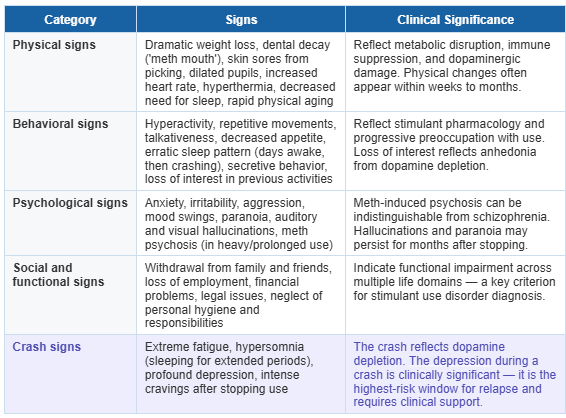
Meth-Induced Psychosis: What Families Need to Know
Meth-induced psychosis is a medical condition — not a personality change. Heavy or prolonged methamphetamine use can produce paranoid delusions, auditory and visual hallucinations, and agitation that are clinically indistinguishable from a schizophrenic episode.
This is frightening for families to witness. It requires clinical management — not confrontation. Meth-induced psychosis typically resolves with abstinence, though it may persist for weeks to months in severe cases. Co-occurring psychotic disorders can be unmasked or worsened by methamphetamine use, making comprehensive psychiatric evaluation essential in treatment.
How Meth Addiction Is Treated in Virginia
Unlike opioid or alcohol use disorder, there is no FDA-approved medication specifically for methamphetamine use disorder. Treatment relies on behavioral therapies that have the strongest evidence base for stimulant addiction:
- Contingency management — the most evidence-supported behavioral treatment for stimulant use disorder; uses structured incentives for verified abstinence
- Cognitive Behavioral Therapy (CBT) — addresses the thought patterns and triggers that maintain meth use
- Motivational Enhancement Therapy (MET) — builds and sustains motivation for recovery during the anhedonic period of early abstinence
- Integrated dual diagnosis treatment — addresses the co-occurring depression, anxiety, PTSD, or psychotic symptoms that are present in the majority of people with meth use disorder
- Psychiatric medication management — for co-occurring conditions; antidepressants are commonly used during the crash and early recovery period to support mood stabilization
At Bold Recovery in Virginia, methamphetamine use disorder is treated within IOP and PHP programming that addresses both the stimulant addiction and the co-occurring conditions that sustain it.
Take the First Step Today
If you’re ready to explore your options — or just want to ask questions — reach out today. We’ll guide you with clarity, compassion, and confidence.
.svg)
or message us directly through our website
You don’t have to figure this out alone. Let’s take the next step — together.
- National Institute on Drug Abuse (NIDA). (2024). Methamphetamine Research Report. NIH. Bethesda, MD.
- Courtney, K.E. & Ray, L.A. (2014). Methamphetamine: An update on epidemiology, pharmacology, clinical phenomenology, and treatment literature. Drug and Alcohol Dependence, 143, 11-21.
- American Psychiatric Association (APA). (2022). Diagnostic and Statistical Manual of Mental Disorders (DSM-5-TR). 5th ed., Text Revision. Washington, D.C.
- Peck, J.A. et al. (2014). Methamphetamine-induced dopaminergic neurodegeneration in the brain: Imaging and clinical implications. Current Psychiatry Reports, 16(11), 510.
- American Society of Addiction Medicine (ASAM). (2023). The ASAM Criteria: Treatment Criteria for Addictive, Substance-Related, and Co-Occurring Conditions. 4th ed.
- SAMHSA. (2023). Behavioral Health Treatments for Stimulant Use Disorders. Treatment Improvement Protocol (TIP) Series. Rockville, MD.
Frequently Asked Questions

Related Blog Posts
.png)
Anxiety and Alcohol Abuse: Finding Help in Virginia
Learn how anxiety and alcohol abuse reinforce each other, why alcohol worsens anxiety long-term, and how Bold Recovery in Norfolk VA treats both simultaneously.
.jpg)
Does Aetna Cover Outpatient Drug Rehab?
Find out if Aetna covers IOP, PHP, MAT, and other outpatient drug rehab in Virginia. Learn what Aetna includes, what prior authorization requires, and how Bold Recovery verifies your benefits

Does Blue Cross Blue Shield Cover Rehab in Virginia?
Find out if Blue Cross Blue Shield covers drug and alcohol rehab in Virginia, what levels of care are included, and how to verify your BCBS benefits at Bold Recovery