


What Is Dual Diagnosis Treatment?



Recovery does not always fail because of a lack of effort or commitment. Sometimes it fails because only half the clinical picture was treated.
Dual diagnosis treatment is the clinical approach that addresses the full picture — treating both substance use disorder and co-occurring mental health conditions simultaneously. For more than half of people in addiction treatment, it is the missing piece.
What Is a Dual Diagnosis?
A dual diagnosis — also called a co-occurring disorder — refers to the presence of both a substance use disorder and at least one mental health condition in the same person at the same time.
This is not an unusual situation. It is the statistical norm. SAMHSA's National Survey on Drug Use and Health consistently finds that more than 50% of people with a substance use disorder also meet diagnostic criteria for a mental health condition.
The two conditions reinforce each other. Substances are often used to self-medicate mental health symptoms. Substance use worsens underlying mental health conditions. Untreated mental health conditions dramatically increase relapse risk. This cycle does not break when only one condition is treated.
Which Mental Health Conditions Most Commonly Co-Occur With Addiction?
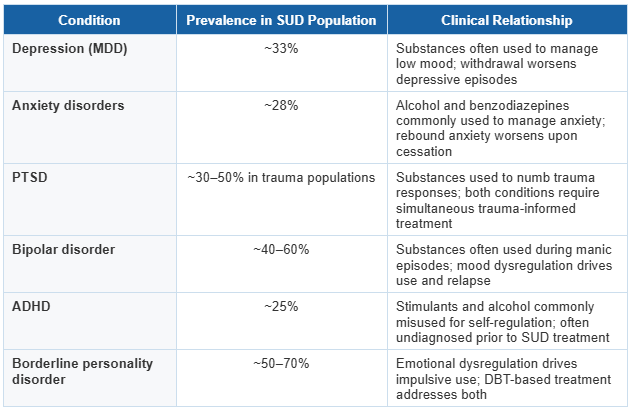
What Does Dual Diagnosis Treatment Actually Look Like?
Integrated dual diagnosis treatment treats both conditions simultaneously — in the same program, by the same coordinated clinical team. This is distinct from sequential treatment, which addresses addiction first and mental health second, and is associated with significantly worse outcomes.
At Bold Recovery in Norfolk, VA, dual diagnosis treatment within IOP and PHP includes:
- Comprehensive psychiatric evaluation at intake — establishing full diagnostic picture
- Individualized treatment plan — addressing both conditions with specific clinical goals
- Individual therapy — including evidence-based modalities such as CBT, DBT, and trauma-focused therapy
- Group therapy — peer processing with clinical facilitation
- Medication management — psychiatric medication for co-occurring conditions where indicated
- MAT integration — where opioid or alcohol use disorder co-occurs with the mental health condition
- Coordinated care — psychiatrist and addiction clinician working from the same treatment plan
The clinical team approach is what makes dual diagnosis treatment effective. Neither condition can be managed in isolation from the other.
Why Does Dual Diagnosis Matter for Relapse Prevention?
Untreated mental health conditions are among the most consistent predictors of relapse. Research shows that people with co-occurring disorders who receive integrated treatment have significantly better long-term recovery outcomes than those who receive sequential or addiction-only treatment.
If you have completed treatment before and relapsed, an unaddressed co-occurring condition is one of the most clinically common explanations. Dual diagnosis evaluation changes the clinical approach — and the outcome.
How Do I Know If I Need Dual Diagnosis Treatment?
A comprehensive clinical assessment determines whether co-occurring conditions are present and clinically significant. You do not need to self-diagnose. Bold Recovery's intake process includes a full psychiatric and addiction evaluation — the clinical picture emerges from that conversation, not from a checklist you fill out online.
Take the First Step Today
If you’re ready to explore your options — or just want to ask questions — reach out today. We’ll guide you with clarity, compassion, and confidence.
.svg)
or message us directly through our website
You don’t have to figure this out alone. Let’s take the next step — together.
- SAMHSA. (2023). Key Substance Use and Mental Health Indicators in the United States: Results from the 2022 NSDUH. HHS Publication No. PEP23-07-01-006. Rockville, MD.
- Regier, D.A. et al. (1990). Comorbidity of mental disorders with alcohol and other drug abuse: Results from the Epidemiologic Catchment Area (ECA) Study. JAMA, 264(19), 2511-2518.
- Drake, R.E. et al. (2004). Integrated dual disorders treatment. In S. Mueser & D. Jeste (Eds.), Clinical Handbook of Schizophrenia. Guilford Press.
- American Society of Addiction Medicine (ASAM). (2023). The ASAM Criteria: Treatment Criteria for Addictive, Substance-Related, and Co-Occurring Conditions. 4th ed.
- National Institute on Drug Abuse (NIDA). (2024). Comorbidity: Substance Use Disorders and Other Mental Illnesses. Drug Facts. NIH.
- Substance Abuse and Mental Health Services Administration (SAMHSA). (2020). Integrated Treatment for Co-Occurring Disorders Evidence-Based Practices (EBP) KIT. HHS Pub. No. SMA-08-4366. Rockville, MD.
Frequently Asked Questions

Related Blog Posts

Does Blue Cross Blue Shield Cover Rehab in Virginia?
Find out if Blue Cross Blue Shield covers drug and alcohol rehab in Virginia, what levels of care are included, and how to verify your BCBS benefits at Bold Recovery
.jpg)
Does Aetna Cover Outpatient Drug Rehab?
Find out if Aetna covers IOP, PHP, MAT, and other outpatient drug rehab in Virginia. Learn what Aetna includes, what prior authorization requires, and how Bold Recovery verifies your benefits
.png)
How Long Does MAT Treatment Last?
Find out how long MAT treatment lasts in Virginia, what determines your duration, when tapering is appropriate, and how Be Bold Recovery structures your medication timeline.