


What Is Medication-Assisted Treatment (MAT)?


There is more stigma attached to MAT than to almost any other evidence-based medical intervention. People call it trading one addiction for another. Clinicians, researchers, and federal health agencies call it a first-line treatment for opioid use disorder.
The data is unambiguous. MAT saves lives, improves treatment retention, and significantly reduces the risk of relapse and overdose. At Be Bold Recovery in Norfolk, VA, MAT is an integrated component of comprehensive addiction treatment—not a standalone prescription.
What Is MAT, Exactly?
Medication-assisted treatment is the use of FDA-approved medications—combined with counseling and behavioral therapy—to treat substance use disorders. The medications work by normalizing brain chemistry, blocking the euphoric effects of alcohol and opioids, relieving cravings, and stabilizing body functions.
MAT is most commonly used to treat:
- Opioid use disorder — including heroin, fentanyl, and prescription opioid dependency
- Alcohol use disorder — reducing cravings and the physical risk of relapse
MAT does not replace recovery. It creates the biological stability that makes therapy and behavioral treatment more effective.
Which Medications Are Used in MAT?
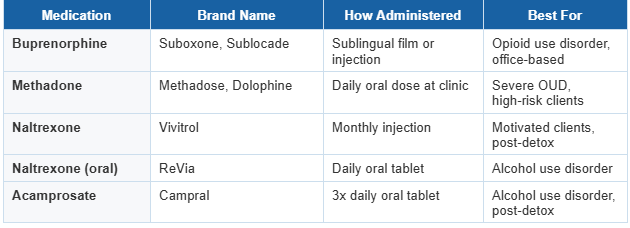
Three medications are FDA-approved for opioid use disorder. Each has distinct clinical applications:
How Does MAT Work at Be Bold Recovery in Norfolk, VA?
MAT at Be Bold Recovery is never administered in isolation. Every client on a MAT protocol participates in a full clinical program — individual therapy, group counseling, relapse prevention, and coordinated care with a prescribing clinician.
The process follows a clear clinical pathway:
- Comprehensive clinical assessment to determine MAT candidacy and medication fit
- Prescribing and dose stabilization with medical oversight
- Integrated programming — MAT runs alongside IOP or PHP, not separately
- Regular medication management appointments and progress monitoring
- Tapering protocol when clinically appropriate — developed collaboratively with your care team
Does MAT Work? What the Research Shows
The clinical evidence for MAT is among the strongest in addiction medicine:
- Buprenorphine and methadone reduce opioid overdose mortality by up to 50%
- MAT patients are 2 to 3 times more likely to remain in treatment compared to those without medication support
- Naltrexone reduces alcohol relapse rates by approximately 36% compared to placebo
- SAMHSA, ASAM, and the Surgeon General all endorse MAT as the evidence-based standard of care for opioid use disorder
MAT does not work because it is easy. It works because it addresses the neurobiological component of addiction that willpower alone cannot resolve.
Is MAT Covered by Insurance in Norfolk, VA?
Yes. Virginia Medicaid covers MAT medications and the clinical services associated with them under the ARTS benefit. Most major commercial insurance plans — including Anthem, Aetna, and Cigna — also cover MAT. Be Bold Recovery's admissions team handles prior authorization and benefits verification for all clients.
Take the First Step Today
If you’re ready to explore your options — or just want to ask questions — reach out today. We’ll guide you with clarity, compassion, and confidence.
.svg)
or message us directly through our website
You don’t have to figure this out alone. Let’s take the next step — together.
- Substance Abuse and Mental Health Services Administration (SAMHSA). (2023). Medications for Opioid Use Disorder. TIP Series No. 63. Rockville, MD.
- American Society of Addiction Medicine (ASAM). (2023). The ASAM Criteria: Treatment Criteria for Addictive, Substance-Related, and Co-Occurring Conditions. 4th ed.
- U.S. Food and Drug Administration (FDA). (2023). Information about Medication-Assisted Treatment (MAT). Silver Spring, MD.
- Sordo, L. et al. (2017). Mortality risk during and after opioid substitution treatment: Systematic review and meta-analysis of cohort studies. BMJ, 357, j1550.
- Virginia Department of Medical Assistance Services. (2024). Addiction and Recovery Treatment Services (ARTS) MAT Coverage Guidelines. Richmond, VA.
- National Institute on Drug Abuse (NIDA). (2024). Medications to Treat Opioid Use Disorder Research Report. NIH.
Frequently Asked Questions

Related Blog Posts
.jpg)
How Many Hours a Day Is PHP Treatment?
Find out how many hours a day PHP treatment runs in Virginia, what a typical daily schedule looks like, and how Be Bold Recovery structures your recovery time.
.png)
Understanding Levels of Care in Addiction Treatment: What’s Right for You?
A clear breakdown of addiction treatment levels of care, from medical detox through PHP, IOP, and standard outpatient, so you can find the right fit with BeBold Recovery.
.jpg)
IOP vs. PHP: Which Level of Care Is Right for You?
Compare IOP and PHP addiction treatment in Virginia. Learn which level of care fits your recovery stage and how Bold Recovery matches you to the right program.