


Xanax Addiction: Signs You Need Help and Where to Turn


Xanax Addiction: Signs You Need Help and Where to Turn
Xanax (alprazolam) is one of the most prescribed medications in the United States. It works fast for anxiety and panic. Millions of people take it as prescribed with no problems. Others develop dependence within weeks of starting, particularly at higher doses or with daily use.
If you or someone you love has been taking Xanax and things feel off, this guide covers what is happening clinically. How Xanax dependence develops, the physical and psychological signs, why abrupt cessation is dangerous, safe treatment options in Virginia, and how to treat the underlying anxiety after getting off the medication.
SAFETY: Do not stop Xanax cold turkey. Alprazolam withdrawal can cause seizures and death. Any dose reduction must be medically supervised. Call your prescriber or a licensed treatment provider first. In an emergency, call 911.
How Xanax Addiction Develops From Legitimate Anxiety Treatment
The pattern is common enough that clinicians recognize it as its own picture:
Stage 1 - The prescription works well. Xanax provides quick, powerful relief for anxiety or panic. Symptoms improve. Life feels manageable again. Both patient and prescriber consider the treatment successful.
Stage 2 - Tolerance builds within weeks. The same dose produces less relief. Anxiety symptoms return between doses. This is not psychological. The brain's GABA system adapts to the medication's presence.
Stage 3 - Dose escalates or frequency increases. The patient takes an additional pill, or refills a few days early, or asks for a higher dose. Sometimes the prescriber escalates. Sometimes the patient escalates on their own or borrows from friends or family.
Stage 4 - Rebound anxiety between doses. The anxiety felt between doses becomes worse than the anxiety that led to the original prescription. This is not the underlying condition returning. It is inter-dose withdrawal. The medication is now causing the anxiety it was prescribed to treat.
Stage 5 - Physical dependence is established. Missing doses produces withdrawal symptoms. The medication has become medically necessary, not to treat anxiety, but to prevent withdrawal. Patients often describe feeling 'trapped' at this stage.
Stage 6 - Addiction may develop. For some patients, use becomes compulsive. Doctor-shopping, buying from friends or online sources, or transitioning to illicit alprazolam (often counterfeit and potentially contaminated with fentanyl) may follow.
Not everyone progresses through all stages. Many patients stabilize at Stage 3 or 4. The pattern is the same regardless of dose or intent. Nobody predicts in advance who will progress further.
Tolerance, Dependence, and Addiction: Understanding the Progression
These three terms are often confused. They describe distinct processes:
Tolerance. The body adapts to the medication. The same dose produces less effect. Tolerance is a normal physiological response, not misuse.
Dependence. The body has adapted to the point that stopping causes withdrawal. Dependence is a medical condition, not addiction. Many patients on legitimate long-term Xanax have dependence without addiction.
Addiction. Compulsive use despite consequences. Doctor-shopping, hiding use, buying from non-medical sources, using for non-anxiety reasons (sleep, escape, euphoria), continued use despite health or life problems, and inability to cut back despite trying.
A patient can be tolerant without being dependent. A patient can be dependent without being addicted. Treatment approaches differ. Dependence requires medical tapering. Addiction requires medical tapering plus behavioral treatment for the compulsive use patterns.
Physical and Psychological Signs of Xanax Dependence
Watch for these signs:
Physical signs:
- Withdrawal symptoms if a dose is missed (tremor, sweating, irritability, anxiety spikes)
- Needing higher doses to achieve the same effect (tolerance)
- Rebound anxiety between doses (often worse than baseline anxiety)
- Physical symptoms (muscle tension, headaches, GI issues) that resolve with dosing
- Sleep disruption when not at target dose
- Coordination issues, unsteadiness, or slurred speech
- Cognitive fog and memory problems
Psychological signs:
- Preoccupation with the next dose
- Planning activities and travel around dosing schedule
- Anxiety about running out
- Emotional blunting or feeling numb
- Loss of interest in activities previously enjoyed
- Depression
- Feeling 'trapped' or unable to imagine life without the medication
Behavioral signs:
- Requesting early refills
- Seeing multiple prescribers
- Filling at multiple pharmacies
- Borrowing or buying from friends, family, or online
- Hiding use from family or partners
- Failed attempts to cut back or stop
Why Stopping Xanax Abruptly Is Dangerous
Xanax has one of the highest withdrawal severity profiles among benzodiazepines due to its fast onset and short half-life. Abrupt cessation can cause:
- Withdrawal seizures (potentially fatal)
- Delirium and confusion
- Severe anxiety and panic attacks
- Insomnia lasting weeks
- Muscle tension and pain
- Nausea, sweating, tremors
- Cardiac issues in vulnerable patients
- Suicidal thoughts
The risk is higher for patients on higher daily doses, longer duration of use, or with underlying medical conditions. Medical supervision is not optional. It is the standard of care.
Medically Supervised Detox and Tapering Options in Virginia
Safe Xanax treatment typically involves:
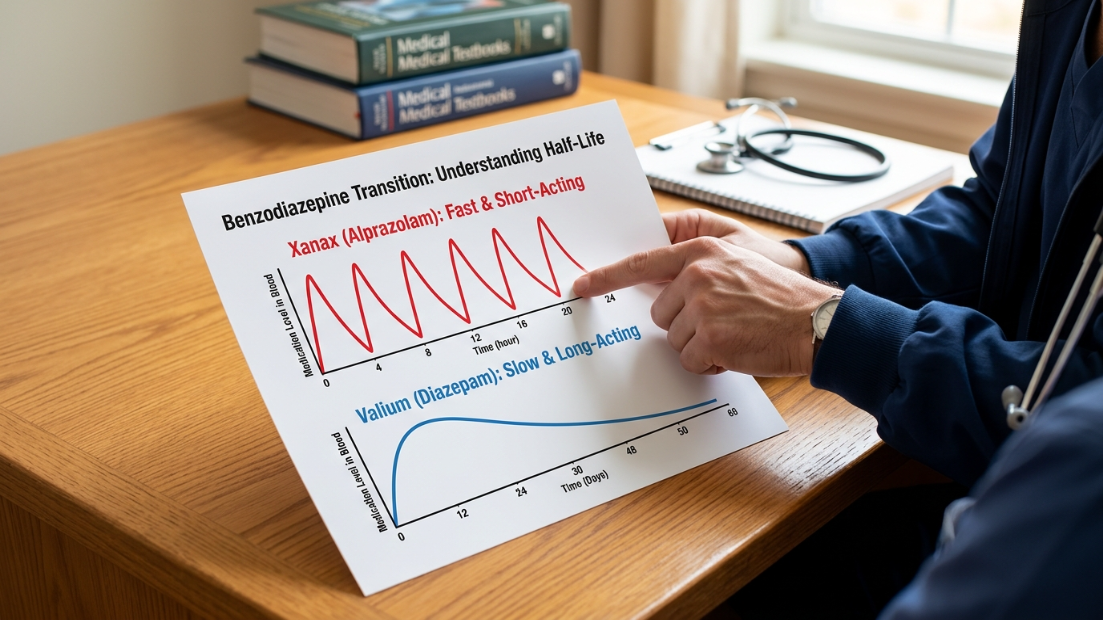
Conversion to a longer-acting benzodiazepine. Most tapers begin by converting alprazolam to equivalent doses of diazepam (Valium). Diazepam's long half-life prevents the inter-dose withdrawal that makes Xanax tapering particularly difficult.
Slow structured taper. Doses typically reduce by 10 to 25 percent every 1 to 2 weeks. The exact pace depends on daily dose, duration of use, and individual response. Full taper often takes 3 to 12 months.
Inpatient or intensive outpatient monitoring for high-dose patients. Higher doses, longer duration, or complex medical situations warrant more intensive monitoring at least through the initial phase.
Adjunct medications for symptom support. Anticonvulsants (gabapentin, pregabalin), beta-blockers, and non-benzodiazepine anxiety medications may support the taper.
PHP or IOP structured programming. During and after the taper, structured therapy programs address underlying anxiety, provide skill-building, and support recovery.
Treating the Underlying Anxiety After Getting Off Xanax
The anxiety that led to the original Xanax prescription may or may not still be present after taper completion. Many patients discover their baseline anxiety was significantly lower than expected. Others continue to have clinical anxiety that needs treatment through non-benzodiazepine methods:
SSRIs and SNRIs. First-line medications for chronic anxiety. Take 4 to 8 weeks to work but produce sustained anxiety reduction without dependence.
Buspirone. Non-benzodiazepine anxiety medication with no dependence potential. Effective for generalized anxiety.
Cognitive Behavioral Therapy (CBT). Evidence-based therapy specifically for anxiety disorders. Often as effective as medication for many anxiety conditions.
Dialectical Behavior Therapy (DBT) skills. Distress tolerance, emotion regulation, and mindfulness skills for managing acute anxiety without medication.
Mindfulness-Based Stress Reduction. Structured 8-week program with strong research support for chronic anxiety.
Exposure therapy. Particularly effective for specific phobias, social anxiety, and PTSD-related anxiety.
Lifestyle interventions. Exercise, sleep hygiene, caffeine reduction, and stress management have significant effects on anxiety.
Most patients benefit from a combination of medication and therapy rather than one alone. The right combination depends on the specific anxiety condition and individual response.
Your Next Step
If you are worried about your Xanax use or a loved one's, do not try to stop alone. Call your prescriber for an honest conversation. If that is not possible or not enough, call a licensed Virginia treatment provider today for a free confidential assessment. Safe taper is possible. Effective anxiety treatment without dependence is possible. The path exists.
Take the First Step Today
If you’re ready to explore your options — or just want to ask questions — reach out today. We’ll guide you with clarity, compassion, and confidence.
.svg)
or message us directly through our website
You don’t have to figure this out alone. Let’s take the next step — together.
- Ashton, C.H. Benzodiazepines: How They Work and How to Withdraw (The Ashton Manual). benzo.org.uk
- U.S. Food and Drug Administration. Xanax (alprazolam) Prescribing Information. fda.gov
- FDA. Boxed Warning About Serious Risks of Benzodiazepines. fda.gov
- National Institute on Drug Abuse (NIDA). Prescription CNS Depressants. nida.nih.gov
- American Psychiatric Association. Practice Guideline for the Treatment of Patients With Panic Disorder. psychiatry.org
- Lader, M. Benzodiazepines revisited - will we ever learn? Addiction
- Substance Abuse and Mental Health Services Administration. TIP 45: Detoxification. samhsa.gov
- American Society of Addiction Medicine. asam.org
- SAMHSA National Helpline. 1-800-662-HELP
- Code of Virginia § 38.2-3412.1. Coverage for Mental Health and Substance Use Disorders. law.lis.virginia.gov
Frequently Asked Questions

Related Blog Posts
.png)
Anxiety Disorders and Substance Abuse: Dual Diagnosis Care
Anxiety and substance abuse often go together. Learn how dual diagnosis care in Virginia treats both with integrated therapy, safe medications, and support.

Benzodiazepine Addiction: How to Get Help Safely
Benzodiazepine addiction and treatment: why withdrawal can be life-threatening, the medical taper process, dependence vs anxiety, and safe detox in Virginia.

How Telehealth Addiction Treatment Works in Virginia
Telehealth addiction treatment in Virginia explained. See what's covered under 2026 DEA rules, how sessions work, MAT presc