PHP Programs in Virginia: Complete 2026 Guide | BeBold

A Partial Hospitalization Program (PHP) in Virginia is a structured, full-day addiction and mental health treatment program that meets five days per week—typically 9 a.m. to 3 p.m. — without requiring an overnight stay. It sits between inpatient hospitalization and standard outpatient therapy, giving you the clinical intensity of residential care while allowing you to sleep at home. BeBold Recovery offers PHP in Norfolk, Virginia, with free transportation from more than 30 cities, including Virginia Beach, Chesapeake, Portsmouth, Newport News, and Hampton.

Quick Answer: PHP is the most intensive outpatient level of addiction and mental health care in Virginia. It is covered by Medicaid, Medicare, and most private insurance plans. BeBold Recovery can verify your benefits within 24 hours. Call 757-716-0067.

Take the First Step Today

Start your recovery - today!
Key changes you’ll experience:
  • Physical detox and brain chemistry recalibration
  • Emotional sensitivity and mental clarity
  • Sleep disturbances or improvement
  • Shift in daily structure and decision-making
Common examples of triggers:
  • Seeing someone using
  • Visiting a place you associate with substance use
  • Stress or emotional turmoil
  • Celebrations or holidays
  • HALT (Hungry, Angry, Lonely, Tired)
Benefits of having a sober network:
  • Reduces feelings of isolation and loneliness
  • Increases accountability and motivation
  • Provides emotional support during cravings or setbacks
  • Encourages personal growth and shared purpose
  • Helps you develop new sober friendships and social activities
Benefits of having a sober network:
  • Reduces feelings of isolation and loneliness
  • Increases accountability and motivation
  • Provides emotional support during cravings or setbacks
  • Encourages personal growth and shared purpose
  • Helps you develop new sober friendships and social activities
Getting back to your career or education can help:
  • Restore self-esteem and purpose
  • Provide structure and routine
  • Rebuild healthy social connections
  • Reinforce your motivation for sobriety
But without a plan, the stress and triggers of busy environments can pose a relapse risk.
Benefits of family involvement:
  • Improves communication and trust
  • Reduces risk of relapse
  • Heals long-standing emotional wounds
  • Promotes accountability and structure
  • Helps break generational cycles
Evidence shows that expressive writing:
  • Reduces stress and anxiety
  • Improves mood and emotional regulation
  • Helps clarify thoughts and triggers
  • Increases self-awareness and decision-making

According to a 2021 study in the Journal of Substance Use, individuals who journaled during recovery reported higher emotional stability and reduced cravings compared to those who did not.

SEO Keywords: addiction recovery journaling, journal prompts for sobriety, how to start a recovery journal, mental health journaling

What Is a PHP Program in Virginia?

A Partial Hospitalization program—commonly called PHP — is a day treatment program for adults living with addiction, mental health conditions, or both. Under the ASAM continuum of care, PHP is the most intensive outpatient level of treatment available in the state.

Unlike inpatient rehab, you don't live at the facility. Unlike standard therapy, you attend every day. According to SAMHSA's Treatment Improvement Protocol 41, structured day programming significantly improves long-term sobriety outcomes—and PHP sits at the apex of that evidence base.

A typical PHP day at BeBold Recovery includes the following:

  • Group therapy sessions led by licensed clinicians (LPC, LCSW, CSAC)
  • Individual one-on-one counseling tailored to your personal treatment plan
  • Psychiatric medication management and mental health oversight
  • Medication-Assisted Treatment (MAT) — Suboxone, Vivitrol, and Sublocade for opioid and alcohol dependence
  • Holistic wellness: yoga, nutrition planning, and mindful exercise
  • Peer support from certified recovery specialists with lived experience
  • Case management: insurance, housing, legal, and employment coordination

How Many Hours Per Week Is PHP?

PHP in Virginia runs 5 days per week, 5-6 hours per day — totaling 25-30 clinical hours weekly. The ASAM Level 2.5 criteria define this as the threshold at which treatment is clinically equivalent in intensity to a hospital admission, without the overnight requirement.

PHP vs IOP vs Outpatient: Which Level of Care Do You Need?

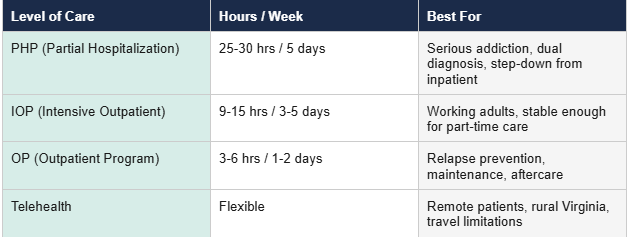
Virginia addiction treatment exists on a continuum. Here is how PHP compares to other levels of care at BeBold Recovery:

Not sure which level fits you? BeBold Recovery offers same-day assessments — our licensed clinicians match you to the right program within hours, not weeks.

Who Qualifies for PHP in Virginia?

PHP is appropriate when standard outpatient treatment is not enough — but a full residential stay is not necessary. You may be a candidate if:

  • You've completed inpatient or residential treatment and need a structured step-down
  • Your addiction or mental health condition is severe enough to require daily clinical support to stay safe and sober
  • You have a dual diagnosis — co-occurring addiction and a mental health condition such as depression, PTSD, anxiety, or bipolar disorder
  • Standard outpatient therapy alone has not been enough to maintain sobriety
  • You need medical oversight for medications or are receiving MAT
  • Your home environment is stable — or BeBold can coordinate sober living housing for you
Referral note for providers: BeBold Recovery accepts same-day PHP referrals from Virginia hospital ERs, discharge planners, courts, probation officers, and Community Services Boards (CSBs). Call 757-716-0067 for direct referral intake.

Week
Physical Symptoms
Emotional Symptoms
1
Fatigue, insomnia, headaches
Anxiety, irritability
2
Muscle aches, sweating
Depression, mood swings
3
Improved energy
Cravings, mental fog
4
Regulated sleep
Optimism, increased clarity
Benefits of having a sober network:
  1. Triggers and Warning Signs
  2. Coping Strategies
  3. Emergency Contacts
  4. Support Network Map
  5. Daily and Weekly Routines
  6. Motivation Reminders
Cravings tend to follow a pattern:
  1. Trigger – Something activates the memory of use
  2. Automatic Thought – "Just one won’t hurt"
  3. Craving – The physical/emotional urge to use
  4. Response – Either coping or relapsing
The key to success: Learn how to pause and interrupt the cycle before it reaches the final stage.
Check circle

1.

Peer Recovery Groups

Join regular meetings with:
  • 12-Step groups (AA, NA, CA)
  • SMART Recovery
  • Refuge Recovery or Dharma Recovery
Check circle

2.

Therapists and Counselors

Licensed professionals can:
  • Guide emotional healing
  • Help address co-occurring mental health issues
  • Offer individualized strategies for staying sober
Check circle

3.

Recovery Coaches or Sponsors

These mentors:
  • Offer lived experience guidance
  • Are available in moments of crisis
  • Help with step work and life transitions
Check circle

4.

Family and Friends

Healthy family members and supportive friends can:
  • Celebrate your milestones
  • Respect your boundaries
  • Show up when it matters most
Check circle

5.

Online Recovery Communities

Digital groups, apps, and forums offer 24/7 access to:
  • Peer encouragement
  • Live chats and forums
  • Accountability trackers
Check circle

1.

Peer Recovery Groups

Join regular meetings with:
  • 12-Step groups (AA, NA, CA)
  • SMART Recovery
  • Refuge Recovery or Dharma Recovery
Check circle

2.

Therapists and Counselors

Licensed professionals can:
  • Guide emotional healing
  • Help address co-occurring mental health issues
  • Offer individualized strategies for staying sober
Check circle

3.

Recovery Coaches or Sponsors

These mentors:
  • Offer lived experience guidance
  • Are available in moments of crisis
  • Help with step work and life transitions
Check circle

4.

Family and Friends

Healthy family members and supportive friends can:
  • Celebrate your milestones
  • Respect your boundaries
  • Show up when it matters most
Check circle

5.

Online Recovery Communities

Digital groups, apps, and forums offer 24/7 access to:
  • Peer encouragement
  • Live chats and forums
  • Accountability trackers

Step 1: Prepare Mentally and Emotionally

Ask Yourself:
  • Am I ready for the stress, pressure, or triggers?
  • Do I have support systems in place?
  • Can I maintain my recovery commitments?

Pro Tip: Talk this through with your sponsor, therapist, or case manager. Create a relapse prevention plan specific to work/school triggers.

Step 2: Set Realistic Expectations

You don’t have to do it all at once. It’s okay to:
  • Start part-time or with fewer classes
  • Work in a lower-pressure role temporarily
  • Take breaks or use leave when needed
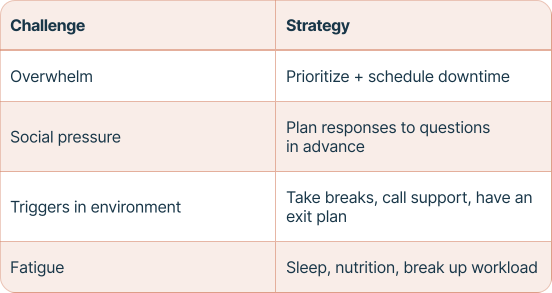
Common Challenges & Coping Strategies

Step 3: Decide What to Share (and With Whom)

You are not obligated to tell everyone. Consider disclosing your recovery only when necessary (e.g., requesting accommodations or sharing with trusted supervisors).

What you might say:
  • “I’m prioritizing my health and have new routines in place.”
  • “I don’t drink/use anymore and focus on my wellness.”

Step 4: Create a Daily Recovery-Friendly Schedule

Include:
  • Morning grounding rituals (journaling, prayer, exercise)
  • Check-in texts with sober peers
  • Lunch breaks in safe spaces
  • After-work recovery meetings or relaxation routines
Common Challenges & Coping Strategies

Step 5: Use Your Support Tools

Essentials for the transition:
  • Sponsor or peer coach
  • Weekly therapy or support group
  • Daily tracker (app or planner)
  • Affirmation cards or motivation journal
Apps to explore:
  • Sober Grid
  • I Am Sober
  • Recovery Path

Step 1: Educate Yourself About Addiction

Understanding the disease of addiction can help you support your loved one with compassion, not blame.

Key topics to explore:
  • Addiction as a brain-based disorder
  • Common co-occurring mental health issues
  • The recovery process: detox, PHP, IOP, OP
  • Relapse risk factors and warning signs

Step 2: Set Healthy Boundaries

Boundaries protect your wellbeing and promote healthier dynamics.

Examples:
  • “I will not allow substances in my home.”
  • “I’m available to talk, but not when you’re high.”
  • “If you miss treatment, I won’t enable excuses.”

Pro Tip: Boundaries are not punishments—they are self-respect in action.

Step 3: Focus on Communication

Effective family communication means:
  • Using “I” statements instead of blame
  • Listening without interrupting
  • Expressing emotions calmly and honestly

Try this formula: “I feel [emotion] when [behavior], because [reason]. I need [clear boundary or request].”

Step 4: Participate in Family Therapy or Support Groups

Healing is faster when families are supported too.

Options to consider:
  • Family therapy through your loved one’s treatment provider
  • Al-Anon, Nar-Anon, or Families Anonymous
  • BeBold Recovery’s #BeOne Family Program

Step 5: Stop Enabling—Start Empowering

Enabling can delay recovery. Empowerment supports responsibility.


Examples of enabling vs. empowering:

Step 6: Practice Self-Care and Forgiveness

You can’t pour from an empty cup.
  • Set aside time for hobbies, therapy, or spiritual practices
  • Talk to a counselor about your feelings
  • Journal about your grief, anger, or hope
  • Allow yourself to forgive—even when trust takes time

Affirmation: “I am allowed to heal, too.”

Take the First Step Today

Start your recovery - today!

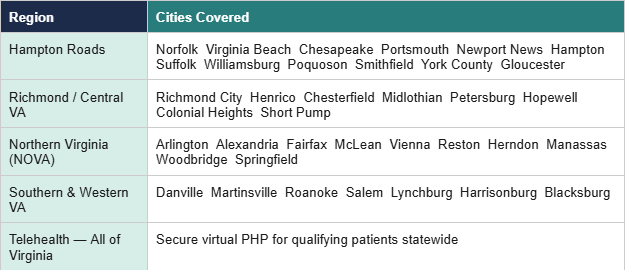
PHP Programs in Virginia — Cities BeBold Recovery Serves

BeBold Recovery's PHP facility is at 5423 Henneman Drive, Norfolk, VA 23513. We serve all of Virginia through free transportation, telehealth, and housing coordination:

Free Transportation: BeBold Recovery provides free rides from all major Virginia cities. Transportation is never a barrier to treatment.

Does Insurance Cover PHP in Virginia?

Yes. PHP is covered by most major insurance plans in Virginia. Under the Mental Health Parity and Addiction Equity Act (MHPAEA), insurers cannot apply more restrictive limits to behavioral health treatment — including PHP — than they apply to medical or surgical conditions of comparable severity.

  • Virginia Medicaid: PHP is a covered benefit. Most enrollees pay $0 out of pocket.
  • Medicare Part B: Covers PHP for mental health and substance use disorders.
  • Aetna, Cigna, Anthem/BCBS, UnitedHealthcare: All major commercial plans cover PHP under MHPAEA.
  • Tricare: Military insurance covers PHP for active duty, veterans, and dependents.
  • Private Pay: Flexible payment plans available — call our team to discuss.
Insurance Tip
Under MHPAEA, your insurer cannot deny PHP at a different standard than they apply to medical or surgical care. BeBold Recovery's billing team will appeal any improper denial on your behalf

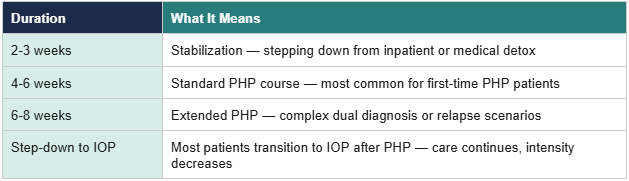
How Long Does PHP Last in Virginia?

Duration depends on your clinical progress, ASAM level-of-care criteria, and insurance authorization. According to NIDA's Principles of Drug Addiction Treatment, treatment lasting fewer than 90 days is of limited effectiveness—which is exactly why BeBold's step-down continuum from PHP to IOP to OP exists.

PHP for Mental Health in Virginia

PHP is not limited to substance use disorders. BeBold Recovery's Dual Diagnosis program integrates psychiatric care directly into PHP, treating both conditions simultaneously. The National Institute of Mental Health (NIMH) notes that people with substance use disorders are twice as likely to have a co-occurring mental health condition — and integrated treatment produces significantly better outcomes than treating each in isolation.

Conditions treated in our Virginia PHP include:

  • Major Depressive Disorder (MDD) and persistent depressive disorder
  • Generalized anxiety disorder, social anxiety, and panic disorder
  • Post-traumatic stress disorder (PTSD) — including combat and military trauma
  • Bipolar disorder (Type I and II), Borderline Personality Disorder (BPD)
  • Any combination of co-occurring mental health and substance use disorders

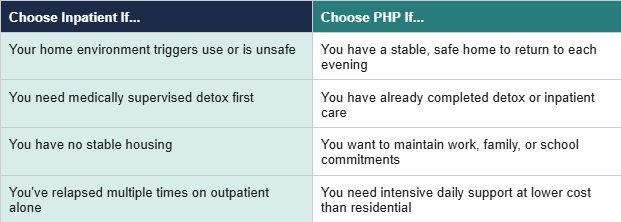
PHP vs. Inpatient — Which Is Right for You?

BeBold Recovery offers both inpatient coordination and PHP — our assessment team recommends the right starting point for your situation.

How to Start PHP at BeBold Recovery — 4 Steps

  1. Step 1—Call or contact us: 757-716-0067 or complete our online intake form. Available same-day, 7 days a week.
  2. Step 2—Immediate assessment: A licensed clinician completes a clinical evaluation within hours — by phone, video, or in-person in Norfolk.
  3. Step 3 — Insurance verification: Our billing team confirms your coverage within 24 hours with no obligation.
  4. Step 4 — Begin PHP: Once cleared, you can start the next business day. We handle transportation, housing, and all paperwork.
Why This Matters
Virginia Statistic: According to the Virginia Department of Health, opioid-related ER visit rates increased more than 52% in Norfolk over the past five years. PHP reduces relapse rates and ER utilization — BeBold Recovery is here to help Hampton Roads heal.

Frequently Asked Questions — PHP Programs in Virginia

What does PHP stand for in mental health?

PHP stands for Partial Hospitalization Program — a structured, full-day clinical program providing intensive therapy and medical oversight without requiring a hospital stay. It is the most intensive level of outpatient care defined by the ASAM criteria.

How much does PHP cost in Virginia with insurance?

With Medicaid, PHP is typically covered at no cost to the patient. With private insurance, out-of-pocket costs depend on your deductible — most patients pay $0-$50 per day. BeBold Recovery verifies your exact benefits before you commit. Call 757-716-0067.

Can you work while in a PHP program in Virginia?

Traditional PHP schedules run Monday-Friday, 9 a.m. to 3 p.m., making full-time employment difficult during active PHP. BeBold Recovery offers flexible scheduling and step-down options. Evening IOP is also available.

What is the difference between PHP and IOP in Virginia?

PHP meets 5 days per week for 25-30 clinical hours. IOP meets 3-5 days per week for 9-15 hours. PHP is more intensive and best for patients with severe addiction, dual diagnosis, or those stepping down from inpatient care.

Does BeBold Recovery offer PHP near me in Virginia?

BeBold Recovery's PHP is in Norfolk, Virginia. We serve patients from across the state — Virginia Beach, Chesapeake, Portsmouth, Newport News, Hampton, Richmond, Arlington, and more — through free transportation. Virtual PHP is available statewide.

What happens after PHP?

After PHP, most patients step down to BeBold Recovery's IOP, then to our standard Outpatient Program. Aftercare planning, sober living coordination, and alumni peer support are included at every stage. Recovery does not end when PHP ends.

How long is a PHP program in Virginia?

PHP programs typically last 2-6 weeks. Most BeBold Recovery patients attend for 4-6 weeks before transitioning to IOP. Your treatment team reviews progress weekly and adjusts the timeline based on your clinical outcomes.

Step 5: Structure Your Routine

Recovery thrives in consistency. Use your plan to:

  • Schedule meetings
  • Set goals and check-ins
  • Plan sober activities and hobbies

Step 5: Keep Growing Your Network

  • Volunteer at recovery events
  • Join sober sports, clubs, or spiritual groups
  • Stay active in alumni or aftercare programs
Phase
What It Looks Like
What You Can Do
Trigger
Passing liquor store
Take a different route
Automatic Thought
“I’ve earned this”
Challenge the thought
Craving
Bi-Sweating, racing heart
Use coping tool (see below)
Response
Urge passes or relapse
Stay connected, ask for support

10 Proven Tools to Handle Cravings

  1. The 5-Minute Rule – Tell yourself to wait 5 minutes before doing anything. Most cravings fade.
  2. Call a Sponsor or Peer – Connection disrupts the craving cycle.
  3. HALT Check-In – Ask: Am I hungry, angry, lonely, or tired?
  4. Breathing Exercises – Deep, focused breathing resets your nervous system.
  5. Mindfulness & Grounding – Focus on the present moment with techniques like 5-4-3-2-1.
  6. Go for a Walk – Physical movement helps reduce anxiety and distracts the mind.
  7. Journal It Out – Write what you’re feeling instead of acting on it.
  8. Change Your Environment – Leave the place or situation that triggered you.
  9. Recovery App Check-In – Use an app like WEconnect or SoberTool.
  10. Attend a Meeting – Get face-to-face or virtual support.

Visual tool:

Day
Morning
Morning
Afternoon
Monday
Journal + Walk
Group Session
Dinner w/ Peer
Tuesday
Meeting + Coffee
Work/School
Recovery App Check-in
...
...
...
...

How to Start Journaling in Recovery

PHP Programs in Virginia — Cities BeBold Recovery Serves

BeBold Recovery's PHP facility is at 5423 Henneman Drive, Norfolk, VA 23513. We serve all of Virginia through free transportation, telehealth, and housing coordination:

Free Transportation: BeBold Recovery provides free rides from all major Virginia cities. Transportation is never a barrier to treatment.

Does Insurance Cover PHP in Virginia?

Yes. PHP is covered by most major insurance plans in Virginia. Under the Mental Health Parity and Addiction Equity Act (MHPAEA), insurers cannot apply more restrictive limits to behavioral health treatment — including PHP — than they apply to medical or surgical conditions of comparable severity.

  • Virginia Medicaid: PHP is a covered benefit. Most enrollees pay $0 out of pocket.
  • Medicare Part B: Covers PHP for mental health and substance use disorders.
  • Aetna, Cigna, Anthem/BCBS, UnitedHealthcare: All major commercial plans cover PHP under MHPAEA.
  • Tricare: Military insurance covers PHP for active duty, veterans, and dependents.
  • Private Pay: Flexible payment plans available — call our team to discuss.
Insurance Tip
Under MHPAEA, your insurer cannot deny PHP at a different standard than they apply to medical or surgical care. BeBold Recovery's billing team will appeal any improper denial on your behalf

How Long Does PHP Last in Virginia?

Duration depends on your clinical progress, ASAM level-of-care criteria, and insurance authorization. According to NIDA's Principles of Drug Addiction Treatment, treatment lasting fewer than 90 days is of limited effectiveness—which is exactly why BeBold's step-down continuum from PHP to IOP to OP exists.

PHP for Mental Health in Virginia

PHP is not limited to substance use disorders. BeBold Recovery's Dual Diagnosis program integrates psychiatric care directly into PHP, treating both conditions simultaneously. The National Institute of Mental Health (NIMH) notes that people with substance use disorders are twice as likely to have a co-occurring mental health condition — and integrated treatment produces significantly better outcomes than treating each in isolation.

Conditions treated in our Virginia PHP include:

  • Major Depressive Disorder (MDD) and persistent depressive disorder
  • Generalized anxiety disorder, social anxiety, and panic disorder
  • Post-traumatic stress disorder (PTSD) — including combat and military trauma
  • Bipolar disorder (Type I and II), Borderline Personality Disorder (BPD)
  • Any combination of co-occurring mental health and substance use disorders

PHP vs. Inpatient — Which Is Right for You?

BeBold Recovery offers both inpatient coordination and PHP — our assessment team recommends the right starting point for your situation.

How to Start PHP at BeBold Recovery — 4 Steps

  1. Step 1—Call or contact us: 757-716-0067 or complete our online intake form. Available same-day, 7 days a week.
  2. Step 2—Immediate assessment: A licensed clinician completes a clinical evaluation within hours — by phone, video, or in-person in Norfolk.
  3. Step 3 — Insurance verification: Our billing team confirms your coverage within 24 hours with no obligation.
  4. Step 4 — Begin PHP: Once cleared, you can start the next business day. We handle transportation, housing, and all paperwork.
Why This Matters
Virginia Statistic: According to the Virginia Department of Health, opioid-related ER visit rates increased more than 52% in Norfolk over the past five years. PHP reduces relapse rates and ER utilization — BeBold Recovery is here to help Hampton Roads heal.

Frequently Asked Questions — PHP Programs in Virginia

What does PHP stand for in mental health?

PHP stands for Partial Hospitalization Program — a structured, full-day clinical program providing intensive therapy and medical oversight without requiring a hospital stay. It is the most intensive level of outpatient care defined by the ASAM criteria.

How much does PHP cost in Virginia with insurance?

With Medicaid, PHP is typically covered at no cost to the patient. With private insurance, out-of-pocket costs depend on your deductible — most patients pay $0-$50 per day. BeBold Recovery verifies your exact benefits before you commit. Call 757-716-0067.

Can you work while in a PHP program in Virginia?

Traditional PHP schedules run Monday-Friday, 9 a.m. to 3 p.m., making full-time employment difficult during active PHP. BeBold Recovery offers flexible scheduling and step-down options. Evening IOP is also available.

What is the difference between PHP and IOP in Virginia?

PHP meets 5 days per week for 25-30 clinical hours. IOP meets 3-5 days per week for 9-15 hours. PHP is more intensive and best for patients with severe addiction, dual diagnosis, or those stepping down from inpatient care.

Does BeBold Recovery offer PHP near me in Virginia?

BeBold Recovery's PHP is in Norfolk, Virginia. We serve patients from across the state — Virginia Beach, Chesapeake, Portsmouth, Newport News, Hampton, Richmond, Arlington, and more — through free transportation. Virtual PHP is available statewide.

What happens after PHP?

After PHP, most patients step down to BeBold Recovery's IOP, then to our standard Outpatient Program. Aftercare planning, sober living coordination, and alumni peer support are included at every stage. Recovery does not end when PHP ends.

How long is a PHP program in Virginia?

PHP programs typically last 2-6 weeks. Most BeBold Recovery patients attend for 4-6 weeks before transitioning to IOP. Your treatment team reviews progress weekly and adjusts the timeline based on your clinical outcomes.

15 Journal Prompts for Addiction Recovery

  1. What does sobriety mean to me today?

  2. What was a recent craving—and how did I respond?

  3. What are three things I’m grateful for right now?
  4. What is one fear I need to let go of?
  5. What do I want to tell my future self?
  6. How have I grown in the past 30 days?
  7. What boundaries do I need to protect my recovery?
  8. What helps me feel grounded and safe?
  9. What am I still healing from?
  10. Who or what inspires me to stay sober?
  11. What does self-compassion look like for me?
  12. What is one truth I need to accept today?
  13. What is one lie I used to believe about myself?
  14. How did I show strength this week?
  15. What would I say to someone struggling today?

Visual Inspiration: Daily Tracker Example

Date
Mood
Cravings?
Triggered?
Insight or Win
Aug 1
Calm
No
No
Woke up early, meditated 10 mins
Aug 2
Anxious
Yes
Yes
Wrote instead of acting on craving
Aug 3
Proud
No
Yes
Handled stress with deep breathing

Pro Tips to Make It Stick

Evidence shows that expressive writing:
  • Keep your journal private to write honestly
  • Don’t judge your writing—there’s no right or wrong
  • Use affirmations to end entries on a hopeful note
  • Reread past entries to see your growth

Affirmation to close with: “I honor my progress, not perfection.”

When to Reach Out

If journaling brings up intense emotions you can’t process alone:

  • Talk to a therapist, peer, or counselor
  • Bring your journal to a group or session
  • Don’t isolate—sharing your story creates healing

Elements of a Strong Sober Support Network

Support Type
Frequency
Purpose
Peer Group
1-3x/week
Shared experience and insight
Sponsor/Coach
Weekly
Accountability & emotional check-ins
Therapist
Bi-weekly
Mental health & trauma support
Family/Friends
Ongoing
Love, encouragement, practical help
Online Communities
Daily
On-demand support & motivation
Week
Physical Symptoms
Emotional Symptoms
1
Fatigue, insomnia, headaches
Anxiety, irritability
2
Muscle aches, sweating
Depression, mood swings
3
Improved energy
Cravings, mental fog
4
Regulated sleep
Optimism, increased clarity
Check circle
Identify

List your top 5 triggers

Check circle
Avoid

Come up with a way to reduce exposure

Check circle
Respond

Assign a coping strategy to each trigger

If you start to feel overwhelmed, reach out. Signs to watch for:
  • Skipping meals or meetings
  • Avoiding friends or isolating
  • Feeling like you’re "faking it"
  • Resentment, burnout, or overcommitment

When to Seek Help

Week
Physical Symptoms
Emotional Symptoms
1
Fatigue, insomnia, headaches
Anxiety, irritability
2
Muscle aches, sweating
Depression, mood swings
3
Improved energy
Cravings, mental fog
4
Regulated sleep
Optimism, increased clarity
Benefits of having a sober network:
  1. Triggers and Warning Signs
  2. Coping Strategies
  3. Emergency Contacts
  4. Support Network Map
  5. Daily and Weekly Routines
  6. Motivation Reminders
If cravings become overwhelming or constant, it may be time for:
  • Medication-assisted treatment (MAT)
  • Intensive outpatient support
  • One-on-one therapy
Check circle

1.

Peer Recovery Groups

Join regular meetings with:
  • 12-Step groups (AA, NA, CA)
  • SMART Recovery
  • Refuge Recovery or Dharma Recovery
Check circle

2.

Therapists and Counselors

Licensed professionals can:
  • Guide emotional healing
  • Help address co-occurring mental health issues
  • Offer individualized strategies for staying sober
Check circle

3.

Recovery Coaches or Sponsors

These mentors:
  • Offer lived experience guidance
  • Are available in moments of crisis
  • Help with step work and life transitions
Check circle

4.

Family and Friends

Healthy family members and supportive friends can:
  • Celebrate your milestones
  • Respect your boundaries
  • Show up when it matters most
Check circle

5.

Online Recovery Communities

Digital groups, apps, and forums offer 24/7 access to:
  • Peer encouragement
  • Live chats and forums
  • Accountability trackers

Affirmations to Stay Focused

Week
Physical Symptoms
Emotional Symptoms
1
Fatigue, insomnia, headaches
Anxiety, irritability
2
Muscle aches, sweating
Depression, mood swings
3
Improved energy
Cravings, mental fog
4
Regulated sleep
Optimism, increased clarity
Benefits of having a sober network:
  1. Triggers and Warning Signs
  2. Coping Strategies
  3. Emergency Contacts
  4. Support Network Map
  5. Daily and Weekly Routines
  6. Motivation Reminders
Repeat these when cravings hit:
  • “This feeling will pass.”
  • “I am stronger than my urge.”
  • “I’ve come too far to go back now.”
Check circle

1.

Peer Recovery Groups

Join regular meetings with:
  • 12-Step groups (AA, NA, CA)
  • SMART Recovery
  • Refuge Recovery or Dharma Recovery
Check circle

2.

Therapists and Counselors

Licensed professionals can:
  • Guide emotional healing
  • Help address co-occurring mental health issues
  • Offer individualized strategies for staying sober
Check circle

3.

Recovery Coaches or Sponsors

These mentors:
  • Offer lived experience guidance
  • Are available in moments of crisis
  • Help with step work and life transitions
Check circle

4.

Family and Friends

Healthy family members and supportive friends can:
  • Celebrate your milestones
  • Respect your boundaries
  • Show up when it matters most
Check circle

5.

Online Recovery Communities

Digital groups, apps, and forums offer 24/7 access to:
  • Peer encouragement
  • Live chats and forums
  • Accountability trackers

Motivation Matters

Benefits of having a sober network:
  • A written list of "Why I Stay Sober"
  • Favorite quotes or mantras
  • Photos of family or future goals
Affirmations to include:
  • "I am worth a life of peace and purpose."
  • "I don’t need substances to feel whole."
  • "Each choice I make builds my new life."

Take the First Step Today

If you’re ready to explore your options — or just want to ask questions — reach out today. We’ll guide you with clarity, compassion, and confidence.

Phone icon
Call us 757-716-0067

or message us directly through our website

You don’t have to figure this out alone. Let’s take the next step — together.

Explore our newest articles below.
PHP Programs in Virginia: Complete 2026 Guide | BeBold

How to Journal for Recovery
September 17, 2025
4 min read

In this guide from BeBold Recovery, we’ll show you exactly how to start, what to write, and how to make journaling a sustainable habit.

John Doe
Addiction Recovery for Families
September 16, 2025
4 min read

This guide from BeBold Recovery offers practical steps to help families navigate addiction recovery—together.

John Doe